Whenever politicians and pundits talk about infrastructure projects that create jobs and put people back to work, they invariably trot out their favorite projects and hook them up to as many current issues as they can. If they think green jobs are the wave of the future and global warming is a dire threat to the survival of the human race, they come up with something like a massive investment in renewable energy to put people back to work and slow down global warming. Things like that.
I have my own pet infrastructure projects -- cleaning up Fresh Kills Landfill and other toxic dumps across America, for example. That one might be incredibly labor intensive.
Or how about something like the Tennessee Valley Authority along the Rio Grande and the Colorado rivers?
I don't know what it would take to clean up and dam up the Rio Grande and Colorado rivers along the U.S. - Mexico border to produce hydroelectric power, but I know you could put solar and wind farms, desalinization plants and hydroponic gardens along those rivers. You could put factories with fences around them there. You could create Economic Development Zones -- joint ventures between the U.S. and Mexican governments, the border states and communities, and the private sector -- guaranteed to attract businessmen eager to create great fortunes by getting in early on government programs. And the power plants and solar and wind farms, along with the desalination plants, factories and who knows what else entrepreneurs might crowd into the development zones, would create a massive barrier to illegal immigration, while providing thousands of jobs.
Friday, July 4, 2025


Tuesday, December 25, 2018
The Studio System Redux
I’m thinking about defending the studio system against promiscuous auteurism. I suspect the studio system may be our best chance to maintain some semblance of quality in film by acting as a gatekeeper, a bestower of a Good Housekeeping Seal of Approval, an imprimatur that narrows our viewing options to an almost manageable way too many now that streaming has kicked into high gear. That’s a role critics have played in the past and the auteur theory was the perfect instrument for separating the wheat from the chaff, the quality art from the kitsch. But in a streaming world of tens of thousands of directors, concentrating on the work of a handful of auteurs seems, well, limited. And the number of true auteurs may be even smaller than some critics believe. Many of the auteurs only made the list because we stretched the definition of authorship. I still believe there have been, are and will be auteurs, but my take now is that only makers like Ingmar Bergman, Pier Paolo Pasolini, John Cassavetes and others who write their own screenplays as well as realize them should be considered authors of films. That reduces the candidates for the exalted status of auteur considerably. “Pantheon” directors like John Ford who primarily realized scripts written by other makers, would be immediately demoted, directors like Tarantino, Wes Anderson, Paul Thomas Anderson, Terence Malik, young Greta Gerwig, Francis Ford and Sofia Coppola, Kubrick, and Oliver Stone would be promoted and directors like Scorsese, Cameron, Bigelow and Scott would become questionable auteurs. Certainly someone like Antoine Fuqua would never make the cut. But wait.
About eighteen years ago I missed King Arthur (2004) when it was first released. There are probably a number of reasons I wasn’t interested in seeing it, primarily, I think, because I had no great interest in Fuqua the director. I had seen Training Day (2001) but wasn’t particularly impressed, and I probably counted Fuqua’s music videos against him. But why I dismissed Fuqua’s film doesn’t matter really, because if I had seen King Arthur in 2004 I would have seen an entirely different film from the one I saw one evening when I was bored, clicked through the movies on Cinemax, and decided to give King Arthur a look. Back in 2004, I hadn’t read Kazuo Ishiguro’s The Buried Giant and tried to imagine ways Ishiguro’s foggy Arthurian England could be rendered on film. And although it was first published in 1956, I hadn’t read Winston Churchill’s A History of the English-Speaking Peoples yet either. When I read the first volume I realized the history of the Saxon conquest of England was as vague as the memories of Ishiguro’s characters in The Buried Giant. The Fifth Century generally is a murky, empty space, lost in time and waiting to be filled.
This was on my mind when I had my first look at Fuqua’s King Arthur. I’ve watched it four times now and I still can’t explain why I am so intrigued and, yes, moved by the film. I understand some of it. I was struck by how much King Arthur resembles a John Ford Western set in the darkness, grime and poverty of Fuqua’s 5th Century England, not just because of the similarities between King Arthur’s knights and Ford’s cavalry officers and cowboys, but also because Fuqua uses portrait shots of his characters to freeze them in time and in our memories the way Ford did, and even goes John Ford one better by using portrait-like close-ups of King Arthur’s knights to transform them from Romans to Sarmatians and to restore them to the Middle East at the end of his film. And King Arthur is a striking example of the way the confluence, the synthesis, of film and literature creates a rich experience for viewers who can bring something of their own to a film. Fuqua’s portrayal of the Romans, Britons and Saxons fits my picture of the Britons, Arthur, his knights and the Saxons in The Buried Giant and in Churchill’s history better than the Medieval rendition of those characters in typical Arthurian films. Fuqua’s mise-en-scène is, for me, powerful and poignant. Like all great myths, the legend of Arthur never fails to entertain. And Fuqua’s King Arthur is a dark and fascinating retelling of that myth. But was it Fuqua the director who did all that, and if it was, how did he get to that place?
King Arthur is a Jerry Bruckheimer production, based on a screenplay by David Franzoni. Without interviewing them it’s impossible to know if the King Arthur project originated with Bruckheimer or Franzoni, but almost certainly it did not originate with Fuqua. And that’s the point. In the case of King Arthur, the track records of the producer and the screenwriter are better guides to the quality of the film than the oeuvre of the director. And that’s very neat, because it is going to be easier to keep track of and predict the quality of the work of production studios than it is to get a handle on the talent of individual makers of streaming film and video. If we get lucky, the studios will step up to the job of making sure that the quality goes in before their names go on. The best bets right now? HBO and Netflix.
For the would-be makers of screenplays and films, information about how the studio system works, how projects are conceived and realized in the real world, will become an increasingly essential part of their education. Surprisingly, just when an explosion of bandwidth makes it easier than ever to make and distribute independent films, studios may become more important to filmmakers and audiences than they were in the heyday of Hollywood.
Everything old is new again. (Hat tip to Peter Allen.)
Monday, December 24, 2018
Time Travel In The Sixties
Compared to the action-packed super-realism of time travel films like the Terminator series, 12 Monkeys and Planet of the Apes, the black-and-white video technology of The Star Wagon, a 1966 television play, written by Maxwell Anderson and directed by Karl Genus, is archaic. But Genus’ direction and the relaxed and intimate acting of a cast that includes Orson Bean, Joan Lorring, Eileen Brennan and Dustin Hoffman make The Star Wagon one of the most entertaining attempts to use the idea of time travel to dramatize the tension between free will and destiny I’ve seen.
The Star Wagon, produced for WNET and NET Playhouse at the time that National Educational Television was evolving into the Public Broadcasting System, is one of the television plays available from distributors like Broadway Theatre Archive who specialize in early television productions. It’s also available as a rental from Netflix.
Taped mainly on location, The Star Wagon follows Bean, a dreamy inventor, and his earthy sidekick, Hoffman, as they try to reverse their fortunes by turning back time. If the outcome of their journey through time seems sappy and predictable nowadays, that may say more about the cynicism of the 21st Century than it does about the naiveté of television audiences in the Sixties, who were comfortable with Hollywood endings, the triumph of good over evil and the idea that innocence, lost in time, can be restored. And some of Anderson’s themes — that there are no great men, that nothing matters more than freedom, and that the business of business is the fleecing of the unwary – seem, in this age of Ponzi schemes and bailouts, downright timeless.
Television is an intimate medium, suited for low-key performances, and Genus’ cast, led by Bean and Lorring in the role of Bean’s long-suffering wife, deliver the kind of casual intimacy seldom seen in film. Genus uses his performers and the low resolution images of early black-and-white video to create a unique mix of impressionism and naturalism. The high contrast images of Genus’ actors, overexposed to the extent that the actors’ bodies seem to glow, are painterly and impressionistic, but the performances Genus and his actors create are natural and realistic.
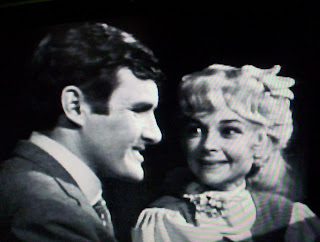
Genus’ cast has a remarkable ability to be with one another, to be with Maxwell Anderson’s script, and to demonstrate that good acting is, in fact, reacting. The result is a kind of naturalness that even directors like John Cassavetes, who were completely committed to naturalism and improvisation, never achieved. Cassavetes was able to use improvisation to structure his films by creating realistic situations, but the dialogue his actors improvised seldom matched Anderson’s ear for small talk, flip comments, and the kind of gentle razzing we see in The Star Wagon.

Anderson and Genus deliver poetry, as well. Standing on the star wagon, Hoffman looks like an angel with one good wing. There is a dreamlike, druggy quality to Bean and Hoffman’s laughter as they launch themselves back through time. Bean moves effortlessly from innocence, as he rehearses a hymn, The Holy City, with Lorring, to funny sexuality as Eileen Brennan digs in his front pocket for candy at a picnic; and Bean’s dark and violent rebirth leaves the impression of opera, of voices singing together to reveal the dark underside of Anderson’s comedy before Hoffman yanks Bean from the river to begin life over, half-drowned and miserable, lying in the mud with his head in Brennan’s wet lap.
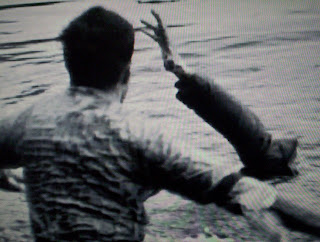
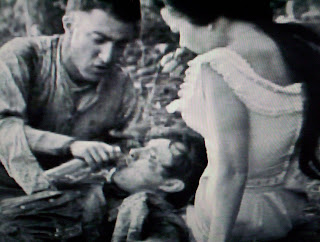
Technically, these scenes of Bean’s death and rebirth by the river are as advanced as any experimental cinema of the Sixties. Bean’s passage begins with the sound of Hoffman pushing Brennan out to the way and jumping into the river, but we aren’t allowed to see Hoffman pull Bean out of the water until we enter the drowning Bean’s thoughts and contemplate nothing less than the meaning of life.
It is possible to think of life as a long series of paths not taken, doors opened or not opened, decisions made one way instead of another. It is a convention of most time travel films that the journey back through time will either change nothing, or it will change everything. The art of those films is to show why this should be so, to explain in a satisfying way why history had to happen exactly as it did happen. In The Star Wagon, Anderson breaks with that convention. He raises the possibility of changing history by going back in time, and then rejects that possibility as an act of will. Orson Bean’s Stephen returns to the present tense of his life as we found him, not because he has to, but because he wants to. But he is better for having made the journey, even if the world is not, and, watching the film, I felt the sweetness of life in a way I had not felt it since those summer evenings long ago, when I was a boy and I waited nervously at shortstop for our pitcher to deliver his first pitch.
At the end of the play, Stephen tells us his time machine is just a way of remembering the past. Karl Genus’ The Star Wagon is as good a way as any of remembering some of broadcast television’s best years. And that’s something, in my view, upon which it is worth spending some time.
The Star Wagon, produced for WNET and NET Playhouse at the time that National Educational Television was evolving into the Public Broadcasting System, is one of the television plays available from distributors like Broadway Theatre Archive who specialize in early television productions. It’s also available as a rental from Netflix.
Taped mainly on location, The Star Wagon follows Bean, a dreamy inventor, and his earthy sidekick, Hoffman, as they try to reverse their fortunes by turning back time. If the outcome of their journey through time seems sappy and predictable nowadays, that may say more about the cynicism of the 21st Century than it does about the naiveté of television audiences in the Sixties, who were comfortable with Hollywood endings, the triumph of good over evil and the idea that innocence, lost in time, can be restored. And some of Anderson’s themes — that there are no great men, that nothing matters more than freedom, and that the business of business is the fleecing of the unwary – seem, in this age of Ponzi schemes and bailouts, downright timeless.
Television is an intimate medium, suited for low-key performances, and Genus’ cast, led by Bean and Lorring in the role of Bean’s long-suffering wife, deliver the kind of casual intimacy seldom seen in film. Genus uses his performers and the low resolution images of early black-and-white video to create a unique mix of impressionism and naturalism. The high contrast images of Genus’ actors, overexposed to the extent that the actors’ bodies seem to glow, are painterly and impressionistic, but the performances Genus and his actors create are natural and realistic.

Genus’ cast has a remarkable ability to be with one another, to be with Maxwell Anderson’s script, and to demonstrate that good acting is, in fact, reacting. The result is a kind of naturalness that even directors like John Cassavetes, who were completely committed to naturalism and improvisation, never achieved. Cassavetes was able to use improvisation to structure his films by creating realistic situations, but the dialogue his actors improvised seldom matched Anderson’s ear for small talk, flip comments, and the kind of gentle razzing we see in The Star Wagon.

Anderson and Genus deliver poetry, as well. Standing on the star wagon, Hoffman looks like an angel with one good wing. There is a dreamlike, druggy quality to Bean and Hoffman’s laughter as they launch themselves back through time. Bean moves effortlessly from innocence, as he rehearses a hymn, The Holy City, with Lorring, to funny sexuality as Eileen Brennan digs in his front pocket for candy at a picnic; and Bean’s dark and violent rebirth leaves the impression of opera, of voices singing together to reveal the dark underside of Anderson’s comedy before Hoffman yanks Bean from the river to begin life over, half-drowned and miserable, lying in the mud with his head in Brennan’s wet lap.


Technically, these scenes of Bean’s death and rebirth by the river are as advanced as any experimental cinema of the Sixties. Bean’s passage begins with the sound of Hoffman pushing Brennan out to the way and jumping into the river, but we aren’t allowed to see Hoffman pull Bean out of the water until we enter the drowning Bean’s thoughts and contemplate nothing less than the meaning of life.
It is possible to think of life as a long series of paths not taken, doors opened or not opened, decisions made one way instead of another. It is a convention of most time travel films that the journey back through time will either change nothing, or it will change everything. The art of those films is to show why this should be so, to explain in a satisfying way why history had to happen exactly as it did happen. In The Star Wagon, Anderson breaks with that convention. He raises the possibility of changing history by going back in time, and then rejects that possibility as an act of will. Orson Bean’s Stephen returns to the present tense of his life as we found him, not because he has to, but because he wants to. But he is better for having made the journey, even if the world is not, and, watching the film, I felt the sweetness of life in a way I had not felt it since those summer evenings long ago, when I was a boy and I waited nervously at shortstop for our pitcher to deliver his first pitch.
At the end of the play, Stephen tells us his time machine is just a way of remembering the past. Karl Genus’ The Star Wagon is as good a way as any of remembering some of broadcast television’s best years. And that’s something, in my view, upon which it is worth spending some time.
Subscribe to:
Posts (Atom)